

Before you continue reading, I would love to invite you to share this with your daughter. Read it together. Or let her read it on her own. And then talk.
Because becoming a woman should not feel like a silent journey. It should feel understood.

A quiet turning point
There comes a quiet turning point in a girl’s life. It does not always announce itself loudly.
Sometimes it begins with small shifts. Clothes fitting differently. Skin changing. Emotions feeling heavier or brighter than before. Sometimes it arrives with a first period. Sometimes with a question in front of the mirror: “Is this normal?”
For parents, it can feel sudden. For girls, it can feel confusing.
But puberty in girls is not chaos. It is transformation. And transformation deserves understanding.
This is why supporting teenage girls through puberty matters so deeply. The way we respond during these years shapes confidence, body image, and long-term health.
What is really happening inside the body
Puberty begins in the brain. A control center switches on and starts sending signals to the ovaries.
Estrogen rises. Progesterone begins to fluctuate. Even small amounts of testosterone increase.
These teen hormones do not only prepare the body for menstruation. They influence skin, mood, sleep, appetite, stress response, and energy levels.
Most girls begin breast development between eight and thirteen years old. The first period usually comes between ten and fifteen. In the first couple of years, irregular periods in teens are common because the hormonal communication system is still maturing.
Irregular does not automatically mean abnormal.
There are moments, however, when it is helpful to pause and seek medical advice. Severe menstrual pain that interrupts daily life. Extremely heavy bleeding. Cycles disappearing for months after being regular. Dramatic weight loss. Signs of restrictive eating.
This is about awareness, not fear.
The emotional storm has a neurological explanation
At the same time, the adolescent brain is developing rapidly.
The emotional center matures earlier than the rational planning center. This is why teenage girl mood swings can feel intense. Feelings become stronger before self-regulation fully stabilizes.
Friendships feel deeper. Comparison feels sharper. Criticism hurts more.
It is not weakness. It is neurobiology.
When we understand this, we respond with patience instead of judgment.
The body changes and so does identity
One of the most sensitive parts of puberty is how the body reshapes itself.
Hips widen. Body fat increases. Breasts develop, sometimes unevenly. Weight may rise before height catches up.
This increase in body fat is not a flaw. It is necessary. Female bodies require a certain amount of fat to balance your hormones, maintain bone health, and support menstrual cycles.
Yet we live in a culture that praises thinness. Teenage girls grow up in constant comparison. Body image in teens can become fragile very quickly.
Comments about weight, even when casual, can stay in a girl’s mind for years. Conversations about weight loss or trying to lose weight must be handled carefully. At this stage, the focus should never be shrinking the body, but building strength, confidence, and healthy habits.
Health matters more than size.

Nutrition is the foundation, not the enemy
Hormones are built from nutrients. Mood stability depends on blood sugar stability. Energy depends on regular, balanced meals.
When meals are skipped or replaced with ultra processed foods, blood sugar rises quickly and crashes. This can lead to irritability, fatigue, cravings, and sometimes cycle irregularity.
Ultra processed foods, when consumed excessively, can promote inflammation and disturb teen gut health. The gut and brain are connected. Gut health influences mood, focus, and even how we handle stress.
This is not about perfection. It is about patterns.
Teen nutrition for hormones should include:
- Adequate protein for growth
- Iron once menstruation begins
- Healthy fats to support brain development
- Magnesium to ease cramps and support sleep
- Zinc for skin health
- Fiber-rich foods that support gut health and natural detox pathways
When we support digestion and choose more anti-inflammatory foods, we help reduce inflammation and create a stable internal environment. This supports mood, skin, cycles, and energy.
Food should never create guilt. But it also should not be chaotic. Adolescence needs structure with flexibility. Guidance without shame.
healthy habits for teenage girls
Small daily habits make a powerful difference.
Regular meals help balance your hormones.
Gentle exercise such as walking, swimming, or yoga supports circulation, mood, and bone strength.
Movement is not about weight loss. It is about strength and confidence.
Sleep protects emotional stability and helps gain energy naturally.
Limiting ultra processed foods helps reduce inflammation and supports clearer skin.
We are not trying to detox in an extreme way. The body already has natural detox systems. We simply support them with nourishing food, hydration, and rest.
These habits protect long-term health. They also create a foundation that makes future weight loss conversations, if ever needed in adulthood, healthier and more balanced.
The balance between control and freedom
Rigid, fear-based parenting creates silence. Complete lack of boundaries creates instability.
What girls need is steady presence. Clear information. Emotional safety. A home where questions are allowed and bodies are respected.
Becoming a woman is not something to survive. It is something to understand.
Talk with your daughter
If you are unsure how to start, try simple questions:
- How are you feeling about the changes in your body?
- What do you wish adults understood better about being your age?
- Do you feel pressure from social media about how you should look?
- What helps you feel confident and strong?
Listen more than you correct. Reassure with facts. Normalize change.
This is the heart of any parent guide to puberty.
For the girls reading this
Your body is not betraying you. It is learning. It is adjusting. It is becoming.
You do not have to shrink to be accepted. You do not have to punish your body to control it. You do not have to compare yourself to edited images.
This stage may feel messy, but it is powerful.
One day, you will look back and realize this was the beginning of your strength.
Build yourself with knowledge. Support yourself with nourishment. Protect yourself with kindness. Trust your body.
When a girl understands herself during puberty, she grows into a woman who does not fight her biology. She grows into a woman who stands comfortably in her own skin.
And that is powerful.
Frequently asked questions
1. Are irregular periods normal in the first years?
Yes. In the first one to two years, cycles can be irregular as hormones mature.
2. How can I support my daughter’s mood swings?
Focus on sleep, balanced meals, emotional safety, and open communication.
3. Should teens follow weight loss diets?
In most cases, strict dieting is not appropriate. The focus should be growth, nourishment, and healthy habits.
4. Does food really affect hormones?
Yes. Stable blood sugar, healthy fats, and key nutrients help balance your hormones and reduce inflammation.
5. How does gut health affect mood?
The gut and brain communicate constantly. Supporting gut health can help improve mood and energy.
6. When should I seek medical advice?
If pain is severe, bleeding is very heavy, cycles stop for months, or there are signs of disordered eating.
Join us live: free masterclass
Supporting teenage girls through their hormonal journey
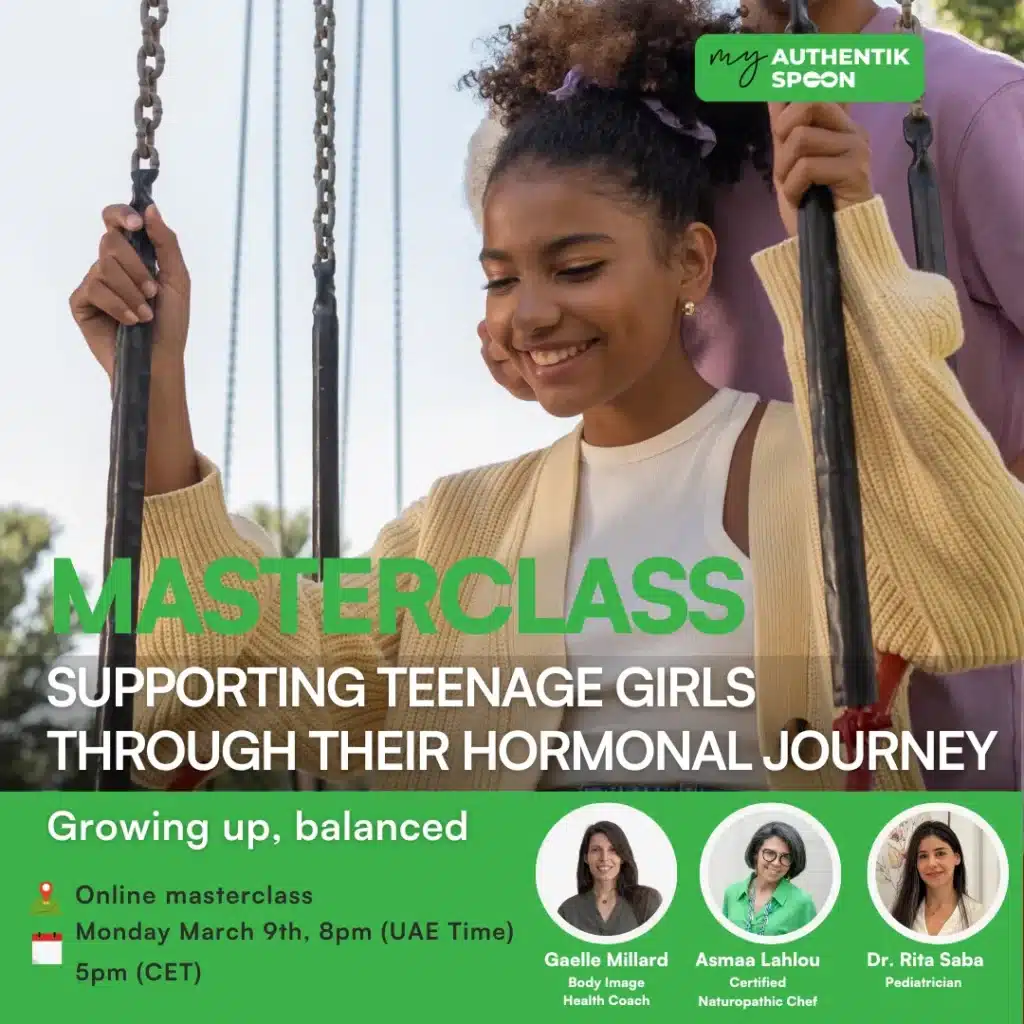
Together with Asmaa Lahlou and Gaelle Millard, we will explore:
- How puberty affects mood and energy
- When acne or irregular cycles need attention
- Key nutrients for hormonal balance
- How to talk about weight without harming self-confidence
If you want clarity and confidence in guiding your daughter through this stage, this masterclass will give you practical tools you can use immediately. Two dates are available, in English and in French. Select the session that works best for you and reserve your spot today.
👉 Click to register and save your spot for this unique masterclass
Want ongoing support to feel your best?
Doors to the Authentik Reset Membership are currently closed, but you can join the waitlist.
Inside the membership, you’ll learn how to:
- improve digestion
- reduce inflammation
- support detox pathways
- balance hormones
- lose weight sustainably
- gain steady energy
A full year of guidance, structure, coaching, and tools, so you don’t have to “start over” again and again.
Ready to reclaim your balance
Join the Authentik Reset Membership waitlist and be the first to know when doors open again. Doors only open for a few days at a time so we can fully focus on welcoming and guiding each new member with the care and attention they deserve.
It’s your space to learn, reset, and feel empowered with expert support, no quick fixes, just lasting change.
Disclaimer
This article is for educational purposes only. It is not a substitute for medical advice, diagnosis, or treatment. Always consult a qualified healthcare professional for personal medical concerns.
Let’s continue learning & growing together!
• Explore our blog for naturopathic recipes and wellness advice.
• Sign up for our newsletter to receive exclusive health content straight to your inbox.
• Share your thoughts and comments on social media and tag us with #myauthentikspoon
About the author

Dr. Rita Saba is a pediatrician and coach at MyAuthentikSpoon. She holds an MD and pediatrics specialty from the Holy Spirit University of Kaslik, along with a subspecialty in neonatology from French hospitals. Fluent in English, Arabic, and French, Dr. Rita is passionate about empowering parents with practical knowledge to care for their children with confidence. If you’re ready to tackle wellness with a fresh perspective, schedule a complimentary private consultation with us to receive personalised dietary insights and weight management strategies. This is your opportunity to have your questions answered and to learn how to incorporate the food choices into your lifestyle and achieve a better wellbeing.

